
You already pay for software. Subscriptions do not share a record. A spreadsheet has a guardian. The real process lives in a chat thread. A new person learns the job by asking whoever is free, a report takes a morning, and a missed step is something a customer tells you about.
Then you ask what one system would cost. One firm prices a login. Another prices phones, a map, payments, and years of files, with the old subscriptions still running. Both call it the same app. Neither sat with the person who does the work on a Tuesday. Custom software development cost is that scope, the promises around it, and what you still pay after launch. Custom software development is how that system gets built. Products we already run come later, as places to start.
Why quotes for the same app vary so much
"The same app" is usually several apps in one sentence.
You said you need something for staff. One quote heard a browser page. Another heard iOS, Android, and a desk console. A third heard offline use, a map, and payments. A fourth heard old spreadsheets moved in while the tools you rent stay up until people trust the new system.
Those are different jobs. To compare figures, both quotes have to price the same list and say what they left out.
What actually drives the cost
Leave one of these out of the brief and it returns later as a change request.
- Scope, features, and roles. Office, field, and customer are three products if each needs a screen and a permission. Write the first release as jobs to be done.
- Platforms: web, iOS, and Android. A web app is one build. iOS and Android add store accounts and a release whenever the work changes. Pay for platforms people will open. Phones in the work means mobile app development.
- Integrations. Payments, text messages, maps, email, accounting, or a sheet someone will not drop: each one depends on another login and someone else's downtime. Name what crosses, and what happens when the other side is down.
- Design. Someone chooses what a person sees, and in what order. UI/UX design finds the workflow before the wrong one is built.
- Data migration. Old sheets, the old app, and notes in people's heads are the business. Decide what is kept, what is dirty, and who checks a sample.
- Offline use, GPS, and payments. A draft has to survive with no signal. GPS ties a clock-in or a stop to a place. Payments include the failure and the refund. Say which you need.
- Testing depth. One happy path is not a test. QA and software testing belongs in the quote as work, sized to the roles and failures you care about.
- Hosting. Servers, backups, and someone who notices an outage. Our hosting, or servers you control, are different bills. Server management is chosen before the number is set.
- Maintenance and change requests. The quote should say how a later change is priced, and who answers when something breaks.
- Where the team sits. Location changes the rate, the hours you share, and who is still there later. A lower rate with no shared day and nobody left to call is a different offer.
The bands below are industry surveys, not a Hashmight price.
Goodfirms' 2026 custom software development cost survey lists a small or MVP baseline under $30,000. The most common band in that survey is a medium project, at $30,000 to $100,000. Clutch's software development pricing guide says custom software projects reviewed on Clutch typically cost $10,000 to $49,999. The average reviewed project on that page is $132,480.29.
A web app plus iOS and Android is not those bands added together. Clutch's app pricing guide says a native iOS app and a native Android app are two codebases, so that pairing doubles the app project. Goodfirms' 2026 app cost survey puts a simple app built as separate native iOS and Android apps at $50,000 to $120,000. The web app is a further build. The real cost depends on scope. Hashmight gives a fixed quote after a free scoping call.
Fixed price, time and materials, or a phased first release
The right contract depends on how well Tuesday can already be described.
Fixed price. The list is written, the price matches it, and a change is a new quote. This fits when you can say what done means.
Time and materials. You pay for time used while the workflow is still being found. It needs a ceiling and a stop. Custom software development rates, or a cost per hour, are not a quote on their own.
A phased first release. Build the workflow that hurts, then choose the next slice. Fix or cap the first phase, and say how each phase is invoiced before work starts.
What you keep paying after launch
Put these beside any build quote before you compare it with subscriptions:
- Servers, backups, and someone watching them
- Updates as phones, browsers, and libraries move on
- Store accounts, and a release for every iOS or Android change
- Who answers, and how a small change is quoted
- A test of each change, so a fix does not break pay, orders, or clock-in
- A period when the old tools still run, on purpose, while you switch
Goodfirms' 2026 custom software cost survey says companies spend an average of 10 to 20 percent a year on post-launch maintenance, bug fixes, and updates. That is an industry figure for upkeep, not a hosting bill and not a Hashmight price. "Included" only helps when it says for how long, and what happens when that period ends.
Build versus a stack of subscriptions
A subscription feels smaller because it arrives monthly. A build feels larger because more of it arrives up front. Compare them over the same period with your own invoices. No survey cited here turns that comparison into a finished total.
On the subscription side, write users × the monthly fee × the number of months, then add the hours spent copying between tools. On the build side, write the first phase, hosting, support, and the months both systems run during the switch. Keep a ready-made tool when it already matches the work. A build earns its place when the stack fights how you operate, when the bill grows as you hire, or when you cannot leave with your data.
How to spend less without a weaker system
Dropping a driver creates a second project. These cuts hold.
One workflow. The missed handoff, the report typed twice, the order nobody can see through. Ship that. The rest waits until people use it.
Platforms people open. Browser first if that is where the office lives. iOS and Android when someone away from a desk is stuck.
A written "not yet". Offline use, GPS, payments, another role, every old file: put deferrals in the quote.
A base that already fits. Extend a system that already schedules field teams, or already takes an order through picking, a till, and a driver. Pay for what is different.
A test of the first week. Try the ugly cases on a smaller build.
Red flags in a quote
Ask again before you sign if you see these.
- One number, and no roles, platforms, integrations, design, migration, testing, hosting, or support.
- "The same app", and no written workflow.
- Design, migration, store releases, or testing pushed to later, with nobody named.
- Changes called free or unlimited. Unlimited means the scope was never closed.
- A rate or a package with no picture of effort and no point where you stop.
- Silence on who owns the code, the designs, and the data.
- Silence on the month after launch.
- A price that is only another rental, with no path to a system you can keep and change.
- Two quotes far apart, and the lower one cannot say which driver it dropped.
What to send for a quote you can compare
Send this before you ask for a number.
- The workflow that hurts, as a Tuesday, from the first trigger to the last record.
- Who does the work, who approves it, and who must not see it.
- Web, iOS, Android, or which of those the first release needs.
- Whether offline use, GPS, or payments are in or out.
- Which other systems it must speak to: a file, a login, or a payment.
- What data must move, a sample, and who checks it.
- What the first release must do, and what waits.
- Who approves the screens.
- Hosted by the builder, or on your servers.
- Fixes, small changes, and the person your team calls after launch.
A partnership, not a rental
Hashmight Solutions builds for businesses that have to run on a Tuesday morning. I have spent 15+ years on that work. The offer is a long-term partnership: the system follows your work, and the same people stay when it changes, rather than a stack you only rent.
On-demand modules means this month's pain first, then the next module once people use the first. Quotes follow modules, users or stores, and hosting. That is how our products are priced, and both can be customised.
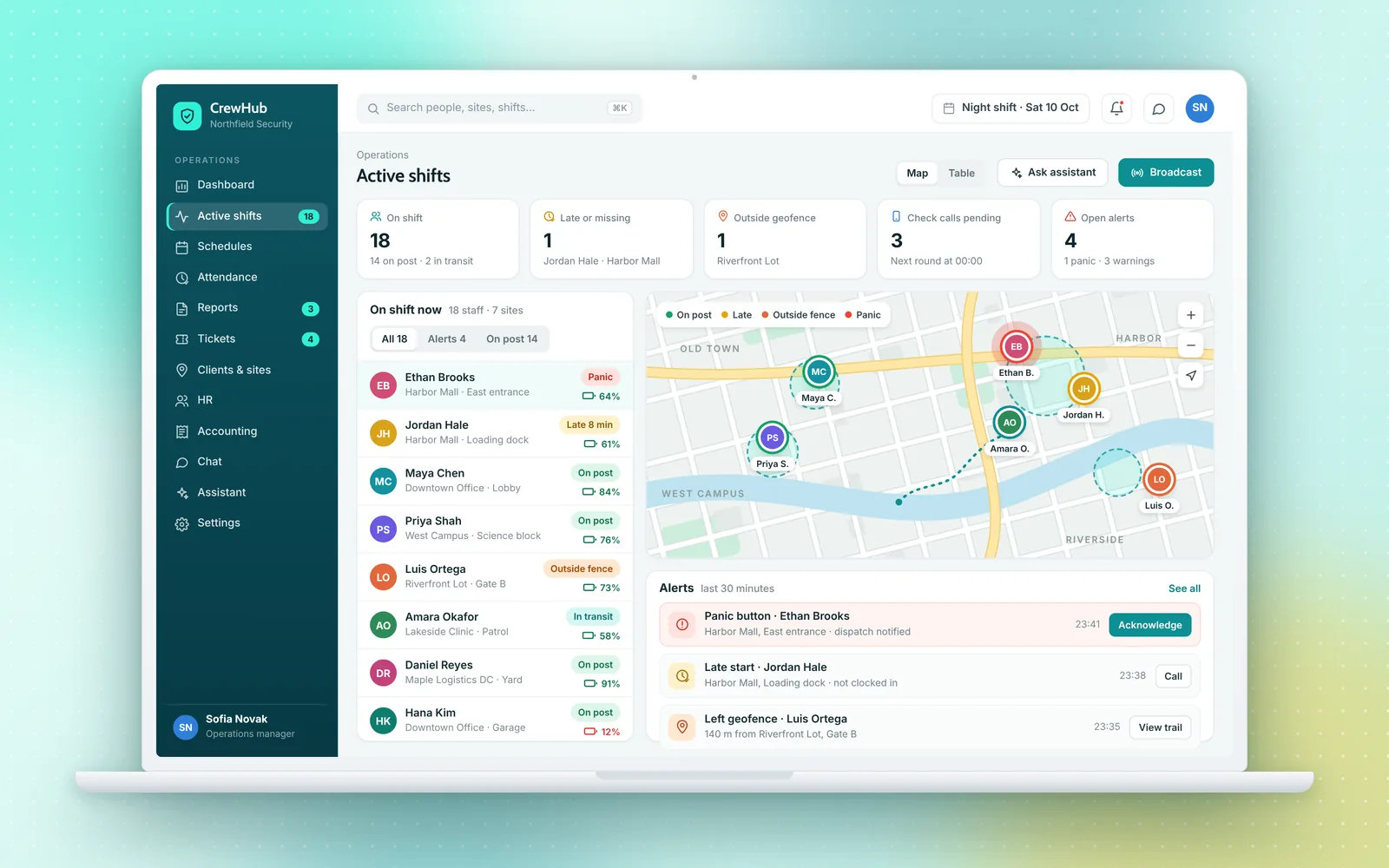
CrewHub is for field teams: scheduling, clock-in at the site, a live view of who is on shift, reports, payroll, and invoicing, on the web and on iOS and Android. We host it, or install it on your servers.
 Opens a larger view
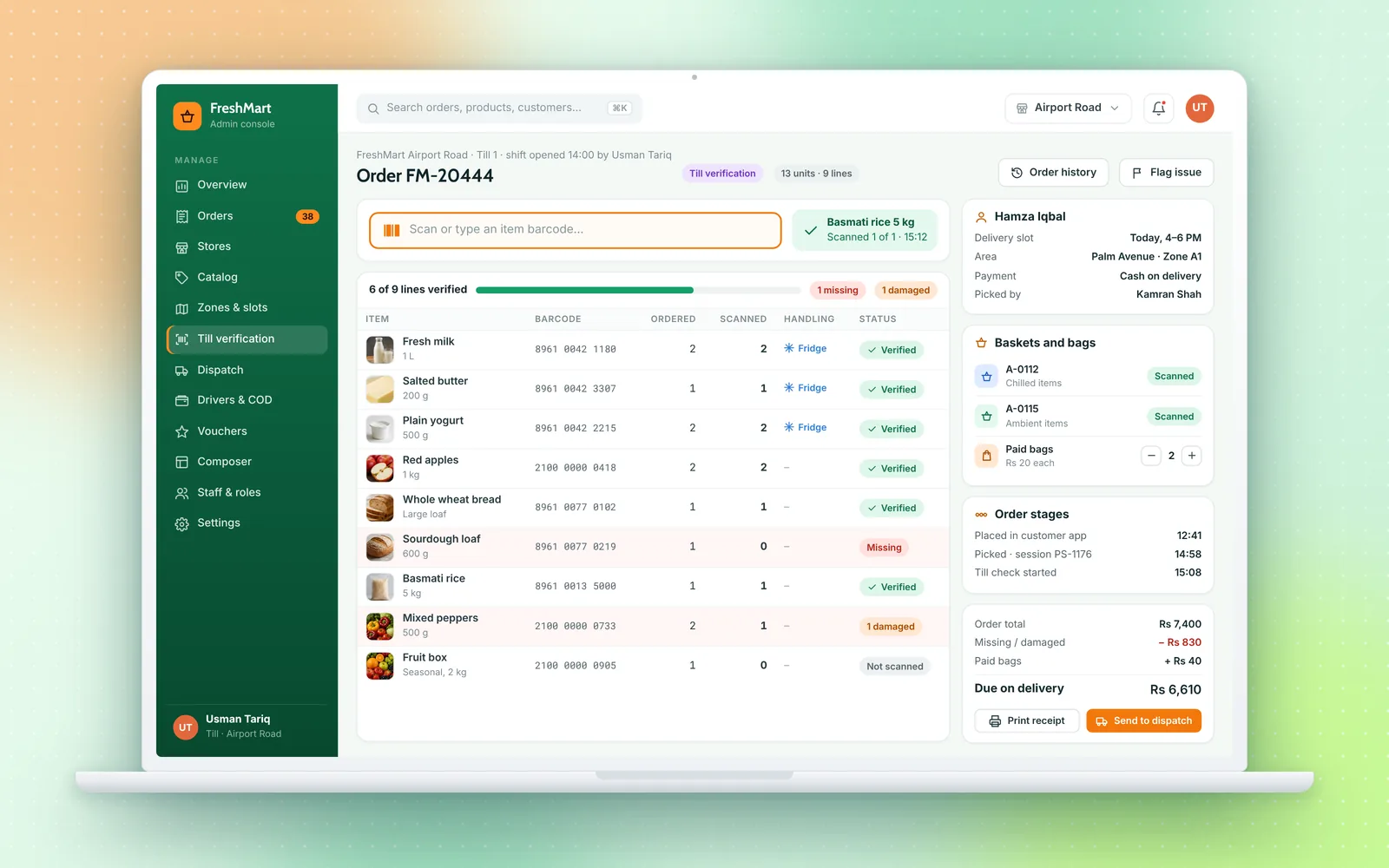
The Enterprise Multi-Store Commerce Solution runs many stores on one system: customer app, picking, till, delivery, and cash at the door. Screens can be customised. What is still rolling out is marked on that page.
 Opens a larger view
If neither fits, we build the workflow and still phase it. See the work with the client unnamed in the case studies: a field team on CrewHub and a retailer on one platform. Then tell us the workflow.
Questions people ask
Is it cheaper to hire freelancers?
A freelancer can suit a small change you can describe completely. A lower rate is not a lower total if design, testing, store releases, hosting, and later support are missing. We quote the first phase rather than guess at someone else's rate.
How long does a custom build take?
As long as the scope. A date with no workflow is a guess. One workflow is a shorter list, so it has a shorter date. The timeline goes in the quote after we have seen the work, the platforms, and the data.
Who owns the code?
Get it in the contract before you sign: the code, the designs, and the data. Extending CrewHub or the Enterprise Multi-Store Commerce Solution is a different offer from a system built only for you. The quote should say which one you are buying. A silent quote is not finished.
Can I pay in phases?
Yes. Agree one workflow, build it, and pay for that phase. Use it, then choose the next. The invoice terms for each phase belong in the quote.
How much does custom software development cost?
No single figure, and no cost per hour, fits every business. Scope, roles, web or iOS and Android, integrations, design, migration, testing, hosting, maintenance, and team location all move it. Send the checklist and we will quote the first phase. WhatsApp https://wa.me/923000917812 or hashmightsolutions@gmail.com.